BCPS Lighthouse Schools
  • Home
  • Schools
  • Reflections
  • Journeys
  • Learning
    • Learner-Centered Environments
    • Nights of Innovation
    • Summer Institutes
  • Press
  • #BCPSLH

What I Wish I Knew...

8/2/2016

 
Submitted by Theresa Driscoll 
S.T.A.T. Teacher, Pikesville High School
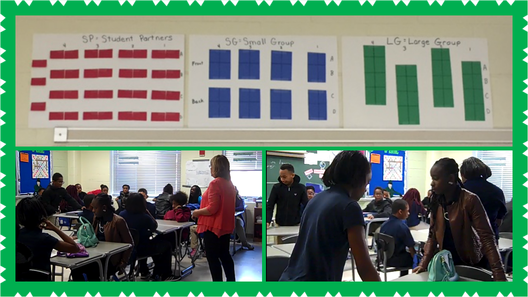
​During the early days of summer, Pikesville High School (PHS) teachers engaged in a week of professional learning to transform their instruction using formative assessment, small group instruction, and meaningful technology integration. Following this experience, teachers were eager to learn more about the challenges that both the students and they would face as they begin the 2016-2017 school year as one of the first BCPS Lighthouse high schools.
 
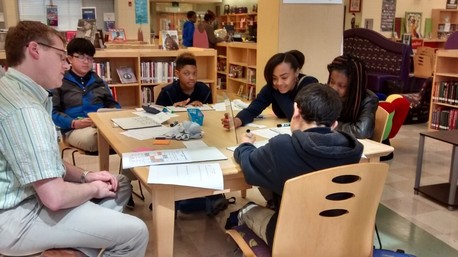
In an effort to answer some circulating questions, I sought out the help of others who embarked on this journey before us in elementary and middle Lighthouse schools. Through this use of VoiceThread, the views of many were captured to not only acknowledge challenges that may arise, but also  help clearly articulate the true meaning of S.T.A.T. Being new to PHS, this tool allowed me to share ways that I could best support teachers in the journey of instructional transformation, while remaining their biggest cheerleader!
​

Peer-Tutoring Supports Student Learning

6/17/2016

 
​Submitted by Niamh McQuillan 
S.T.A.T. Teacher, 
Windsor Mill Middle
Picture
Ms. Hahn’s math class was grappling with a welcomed problem. What purposeful ‘May Dos’ would further student learning and keep students engaged? Ms. Hahn and I devised options: coding math games and creating digital math journals. The students had other ideas—peer tutoring. The plan was music to my ears. Before coming to Windsor Mill Middle School, I was coordinator and elective teacher of a high-school AVID program, the core of which was the tutorial program. A group of five students and I developed a peer-tutoring system based on the AVID model that was grounded in students identifying a point of confusion and peer questioning. As part of the training, students practiced questioning a partner while the rest of the group provided effective feedback based on “I Can” statements. Discovery Ed Coach, Michael Capps pitched in by supporting students in learning the process of effective feedback. During the session, a practice tutor struggled to ask a question to move her partner’s learning forward. In true AVID fashion, an observer-student eagerly asked to join in. “I have a question!” he exclaimed. He posed his question. The group held its collective breath, and the hard-working student had an ‘aha’ moment and solved his math problem.  

History Comes Alive!

6/17/2016

0 Comments

 
Submitted by Niamh McQuillan 
S.T.A.T. Teacher, 
Windsor Mill Middle
Picture
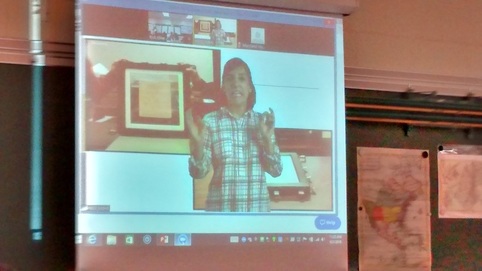
History came alive this year for students in Windsor Mill Middle School social studies classes. Department Chair, Rick Kline, transformed desks into super pods and designed inquiry-based projects for his classes. In March, students ran an election campaign to elect the most effective leader for ancient Rome. Students selected candidates and created Facebook pages, Twitter accounts, and commercials to garner support leading up to the final debate and vote. In April, students researched the role of the Roman Catholic Church in the Middle Ages to determine if the price of the church’s influence was worth the cost. Students vigorously defended their positions with textual references during a lively Philosophical Chair. In May, Chelsea Bracci from the Maryland Historical Society beamed into the classroom, leading a virtual lesson on National Anthems using the Star Spangled Banner original document as a primary source. 
0 Comments

Process is Greater Than Product

5/10/2016

0 Comments

 
Submitted by Emmanuel Andre
S.T.A.T. Teacher, Owings Mills High School
The other day I had an idea on how teachers new to the notion could easily implement small group instruction.  It was pretty basic, but it needed to be so that any teacher at any comfort level could approach the strategy.  This week I’ll be working with an English teacher to implement it and if it goes well, she and I will roll it out to the rest of the staff.  I’m excited.  Being able to make teachers stronger is one of the reasons I got into education.  It is the reason I applied for the STAT position.  It is the reason I support the S.T.A.T. Initiative.

The day we came back from spring break a camera crew showed up at our building and we were named a “Lighthouse” school.  As a former English teacher, I gotta say—I LOVE that metaphor. I love the notion of us learning how to do something, or how not to do something, and then helping others from the vantage point of experience.  It’s a task that I think we are suited for.

Over the past three years I’ve given whole group, small group and one on one professional development to the staff at Owings Mills.  The results are exactly what you think they might be.  Some have taken to the notion of responsive teaching, some have struggled with the idea and some have dismissed it as the next buzzword. We fall across a continuum of current practice, all with the potential to grow and better serve students. For that, I am also excited.

As the status quo shifts, as we learn exactly what these Digital Natives know and don’t know, as we challenge our own notions of good teaching-- we get stronger.  We stand now in the moment right after the before picture but a long way from the after shot.  Over the next year you will get to see the process of our change.  You will hear from teachers, administrators, parents and, of course, students.  Pay attention to our successes and learn from our struggles.  Your before picture was just taken too. 
0 Comments

Using a World Cafe to Foster Professional Learning

4/20/2016

0 Comments

 
Submitted by Niamh McQuillan 
S.T.A.T. Teacher, 
Windsor Mill Middle
Picture
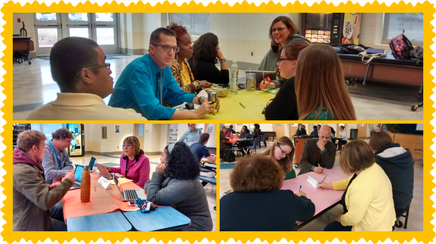
Mindful that the digital conversion moves to the 7th grade next year, 6th grade teachers at Windsor Mill Middle School shared their year-long experience and insight via a World Café during a faculty professional development. Teams gathered at color-coded tables hosted by the 6th grade veterans. Teachers brainstormed responses to questions via a communal ‘table cloth.’ The prompts asked teachers to consider the major shifts they anticipated for a 1-1 Learner-Centered Environment with regard to device management, room set-up, behavior management and establishing classroom expectations.  Teachers also pondered how technology can be used to enhance instruction and not lead instruction. Teams talked and talked, then talked some more, and came away wiser, with tools and understandings to continue the work.  
0 Comments

Using Targeted Small Group Instruction to Close Gaps

4/20/2016

0 Comments

 
Submitted by Niamh McQuillan 
S.T.A.T. Teacher, 
Windsor Mill Middle
Picture
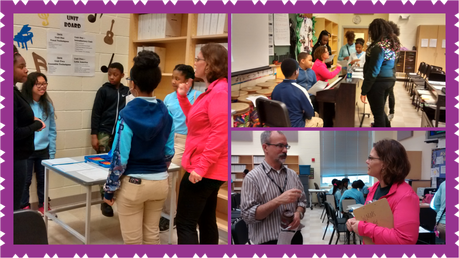
​Vocal Music Teacher, MaryBeth Benesch was intrigued when she first heard of teachers using small-group instruction in their classrooms. She knew the strategy targeted students who had misconceptions or gaps in their learning. The conundrum was: how could she bring this into her vocal music classes? Deer Park Elementary Music Teacher, Kirsten Chalk, an enthusiastic adopter of the learning method, happily invited Benesch into her 5th grade classroom to observe the practice in action. Benesch spent a class period studying Chalk’s procedures and asking student’s questions about the process. The very next day, on her drive into work, Benesch had a Eureka! moment and saw a way to incorporate small-group instruction into her class that very day. A handful of students had joined her class a few weeks into the new semester and needed to learn the basics of sight-reading. Benesch pulled the students at the beginning of class to directly target the gaps in their learning, while the remainder of the class worked in collaborative groups. World Language teacher, Mr. Gaul, joined the impromptu lesson and began to plan his own version of small-group instruction into his Spanish I and II classes.  
0 Comments

WMMS's Lighthouse Room: A Beacon for Learning

4/20/2016

0 Comments

 
Submitted by Niamh McQuillan 
S.T.A.T. Teacher, 
Windsor Mill Middle
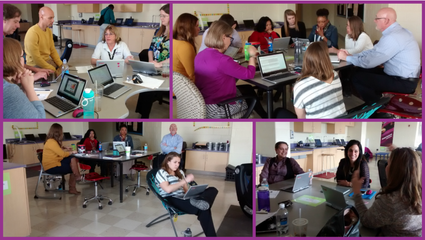
During the darkest months of winter, Windsor Mill Middle School’s Lighthouse Room lived up to its name as a beacon for learning. In February, teachers gathered with the offices of Curriculum and Instruction and Digital Learning to delve deeply into the art and science of designing powerful instruction that infused the purposeful use of technology. S.T.A.T Resource Teacher, Sandra Schmidt coordinated the two-day in-house professional development, bringing in content-area and technology experts to plan lessons with teachers from 6th, 7th, and 8th grades.
Picture
Social Studies Department Chair, Richard Kline, said it was “beneficial to have the opportunity to work with both our content area experts and the Office of Digital Learning.” And indeed, the collaborations proved successful. Teams created lessons that melded Newton’s Laws of Motion and Pirate Ships; asked how Civil War technology changed the course of the war; and examined the connection between India’s Independence movement and self-actualization.   
0 Comments

Fluid Movement

4/8/2016

0 Comments

 
Submitted by Teresa McGuire
Social Studies Teacher, 
Windsor Mill Middle
Picture
Teaching social studies is an ever-changing adventure and requires a classroom that is flexible.  At the beginning of the year I was struggling with making the room cohesive with responsive lessons.   There were many times when students needed to work together in small or large groups.  Other times required more direct instruction.  The solution for me was to create a more fluid room arrangement.  In this type of classroom, the students create the type of arrangements that fit the lesson.  Sometimes the students work independently or with a partner.  Other times they need to work in small, or even large groups of 6-8.  By making a few quick and easy transitions, the desks can be moved and partners can now join up with other to create groups.  In this, lessons can flow from group instruction, to research with a partner for reinforcement to group projects and then back again to accommodate the next class.  
0 Comments

Leveraging Technology to Differentiate Learning

3/28/2016

0 Comments

 
Submitted by Stacie Elliott 
6th Grade ELA Teacherr, Dumbarton Middle School
Picture
My Lighthouse journey reached new heights when I combined flipped learning, formative assessment, and small group instruction to move students towards a summative assessment on identifying direct objects.  Yes, the lesson took time to plan, but once in the classroom, activities flowed seamlessly and students’ reflections noted how “awesome” and “helpful” they found the aforementioned methods in helping them meet the lesson’s objective.  The night prior to this lesson, students watched an Office Mix I created reviewing subjects, verbs, and prepositional phrases and introducing direct objects.  Students’ learning took place in the individual space, so students were ready to apply direct objects the next day.  When students entered the classroom the next day, they engaged in a Kahoot so I could formatively assess who was ready to move on and who still needed my help with direct objects.  Kahoot then made it quick and easy to group students; I downloaded the results and created groups in the time it took students to put away their devices.  As the period progressed, students’ who grasped the grammar concepts followed step-by-step instructions in small groups and applied the “ask three before me” procedure to complete their task in labeling sentences and then composing their own sentences that included direct objects.  While some students worked in small groups, I was able to target students who were struggling with identifying direct objects.  Eventually all students met at the end of the lesson and were summatively assessed on the same objective, but their methods of reaching that goal differed.  As one student stated, “I liked that the people who knew what they were doing weren’t bored waiting for the others to catch up!”   

0 Comments

Hour of Code 

2/26/2016

0 Comments

 
Submitted by Niamh McQuillan 
S.T.A.T. Teacher, 
Windsor Mill Middle
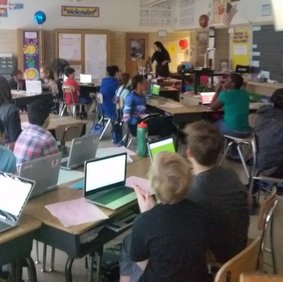
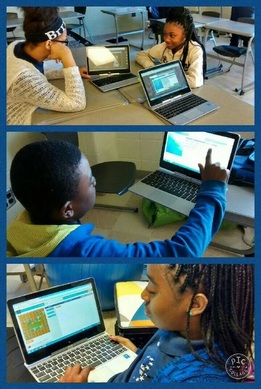
Is Windsor Mill the next Silicon Valley? In early December, students in Delenick’s 6th grade math classes forayed into the world of SDMs and KLOCs when they participated in the Hour of Code. The Hour of Code, a global movement, is an introduction to computer science designed to demystify code and show that anybody can learn the basics. Observed Delenick, “The students might have never known a profession like this exists if they hadn’t had have the chance to try it.” Delenick’s students created their own adventures in the Star Wars Galaxies, Minecraft, and the icy world of Frozen and navigated through the challenges with perseverance and critical thinking. Delenick noted, “Students were frustrated at first if they couldn’t get a program to work the correct way, but they kept trying and were ecstatic and hungry for more when they realized their controls were creating their game. It is a misconception that you have to be a strong math student to code; learning to code makes you a stronger math student. The students didn’t realize they were improving their skills.”
​
Picture
0 Comments
<<Previous
Forward>>

    Authors

    Reflections from teachers, administrators, and students at the Lighthouse Schools.

    Categories

    All
    Administrator
    Art
    Community Engagement
    Counselor
    Digital Citizenship
    Digital Tools
    Flipped Learning
    Language Arts
    Learner Centered Environment
    Maker Learning
    Math
    Music
    Personalized Learning
    Physical Education
    Professional Development
    Project Based Learning
    Real World Connections
    Research Skills
    Science
    Small Group Instruction
    Social Studies
    Student
    Teacher
    Technology

    RSS Feed

    Archives

    June 2018
    May 2018
    April 2018
    March 2018
    February 2018
    January 2018
    December 2017
    November 2017
    October 2017
    July 2017
    June 2017
    May 2017
    April 2017
    March 2017
    February 2017
    January 2017
    December 2016
    November 2016
    October 2016
    August 2016
    June 2016
    May 2016
    April 2016
    March 2016
    February 2016
    January 2016
    December 2015
    November 2015
    October 2015
    June 2015
    May 2015
    April 2015
    March 2015
    February 2015
    January 2015
    December 2014
    November 2014
    October 2014
    September 2014
    August 2014
    July 2014
    June 2014

Team BCPS Logo

© 2015 Baltimore County Public Schools. All rights reserved. 

Proudly powered by Weebly